Back to Blog
Foot ComfortComfort ShoesWalking ShoesFoot HealthArch Support
Why do your feet get tired after a day of standing?
by Revitalign Journal Editorial Team|
Have you ever reached the end of the day with just one desire: to take off your shoes?
Maybe you didn’t work out or walk for miles. You simply spent many hours at work, ran a few errands, walked around town, or spent most of the day on your feet.
Yet your feet feel tired.
It’s a very common feeling, and there’s an intuitive explanation for it: throughout the day, our feet constantly support our bodies and make contact thousands of times with the ground and the shoes we’re wearing.
That’s why comfort isn’t just about how soft a shoe feels when we try it on.
What matters most is how it supports us, step by step, throughout the entire day.
Why might our feet feel more fatigued at the end of the day?
Let’s think for a moment about how much we ask of our feet.
They support our body when we’re standing still, help us maintain balance, adapt to different surfaces, and play a role in every step we take.
Furthermore, while walking, the foot constantly changes its function: it absorbs contact with the ground, bears the load, and contributes to the push-off phase that propels us toward the next step.
It’s a natural process we repeat constantly, often without even realizing it.
When we spend many hours on our feet or walk for long periods, this repetitive activity can contribute to the feeling of fatigue we experience at the end of the day.
And this is where what we wear on our feet also becomes important.
Standing and walking are not the same thing
It may seem curious, but spending a lot of time standing still and walking involve different conditions.
When we walk, our weight is constantly shifting from one foot to the other, and our muscles and joints are engaged in the movement.
When we stand still for a long time, however, the body maintains a relatively static position, and pressure can build up in the same areas for longer periods.
That’s why a day spent behind a counter, at a trade show, in a store, or simply working long hours on your feet can be challenging even without covering great distances.
Everyday comfort, therefore, isn’t just for people who walk a lot.
It also concerns those who spend a lot of time on their feet.
When the Right Shoe Makes All the Difference
A shoe cannot eliminate the natural fatigue of a busy day.
However, it can influence how the foot interacts with the ground.
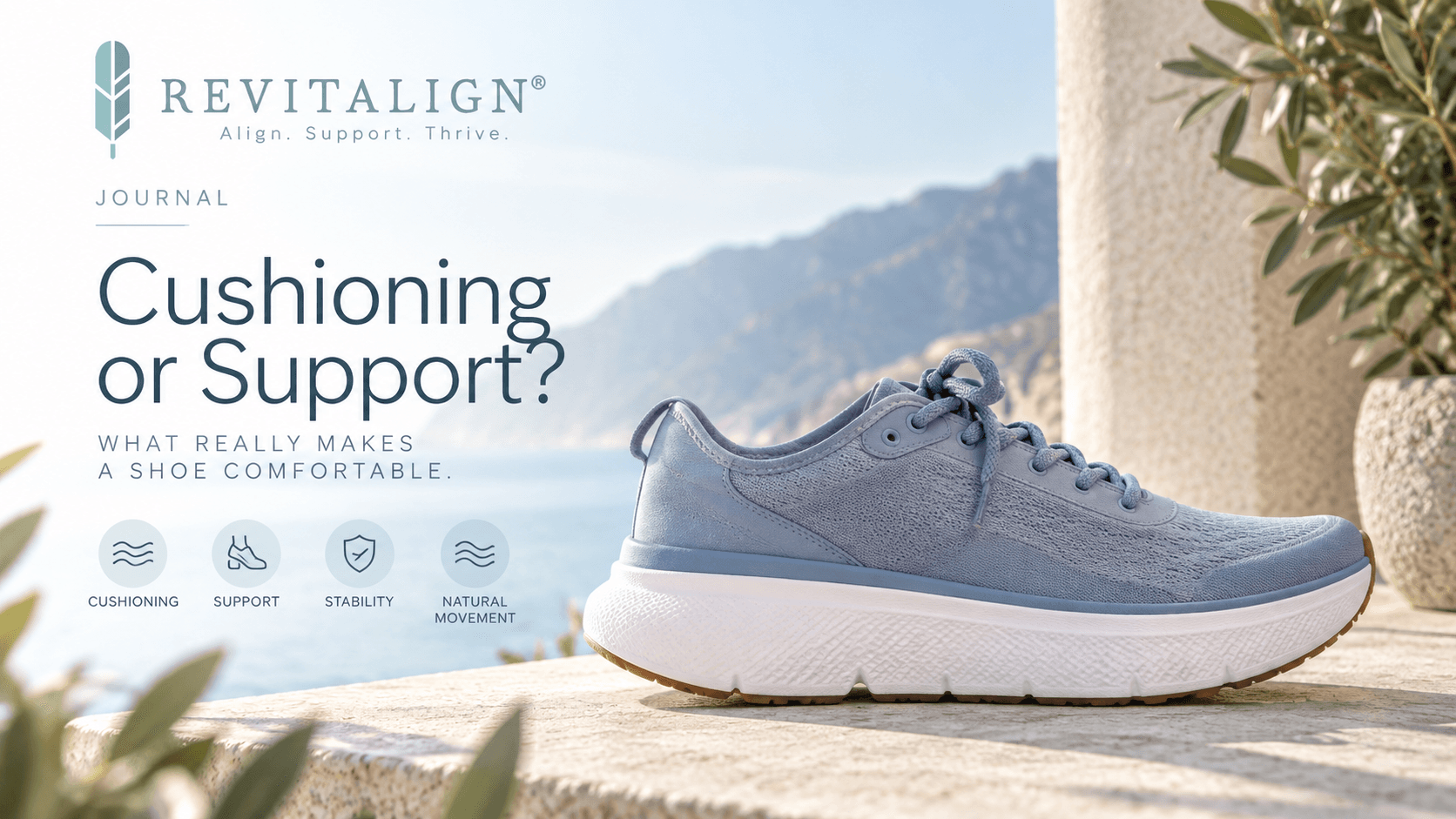
Fit, cushioning, stability, flexibility, and support all work together to contribute to the overall sensation we experience while wearing them.
And that’s exactly the point: comfort doesn’t depend on a single feature.
An extremely soft shoe may feel fantastic in the first few minutes, but that doesn’t necessarily mean it will be just as comfortable after many hours.
The foot needs to find a balance between freedom of movement and support.
Does “softer” really mean “more comfortable”?
It’s one of the most common myths when choosing a shoe.
We press the insole with a finger, feel that it’s soft, and immediately think:
“This is going to be so comfortable.”
The initial sensation matters, of course. But comfort is a more complex and personal experience.
Research on footwear comfort shows that perception depends on the interaction between various factors, including fit, midsole characteristics, pressure distribution, and individual preferences.
That’s why a good shoe should strike a balance: it should cushion without becoming unstable, provide support without feeling stiff, and follow the foot’s natural movement without constricting it.
It’s the difference between the comfort of the first five minutes and the comfort we seek throughout an entire day.
What should you look for in a shoe to wear all day?
There’s no such thing as a perfect shoe for everyone. Foot shape, daily activities, and personal preferences can vary greatly.
However, there are a few aspects worth considering.
A natural fit
Your toes should have enough room, and your foot shouldn’t feel any noticeable pressure points.
A shoe may be very soft, but if the shape doesn’t fit your foot, it’s unlikely to remain comfortable for long.
Stability without stiffness
Your foot should feel supported, but not restricted.
A good shoe should strike a balance between a stable base and the freedom needed for a natural stride.
Balanced cushioning
Cushioning helps soften the impact with the ground, but it shouldn’t be evaluated simply based on how soft the sole is.
Softer does not automatically mean better.
Foot support
The shape of the insole and the way it contacts the foot can contribute to a sense of support and stability.
Arch support in a modern comfort shoe doesn’t necessarily have to be associated with the idea of orthopedic footwear.
It can simply be part of a design intended to support the foot during everyday life.
Did you know?
The comfort of a shoe is partly subjective.
What one person finds extremely comfortable may not produce the same sensation in another.
That’s one reason why trying on a shoe and assessing how it fits your own foot remains essential.
Technology can help.
But in the end, it’s your foot that makes the most important judgment.
Comfort should last longer than just a few minutes
This is perhaps the most useful question to ask when buying a new pair of shoes:
“How will I feel in these shoes after several hours?”
We’re used to judging a pair of shoes based on the few minutes we spend in the store.
Our lives, however, take place outside the store.
We walk.
We work.
We travel.
We go grocery shopping.
We go out with friends.
We take our kids places.
And we often wear the same pair of shoes for most of the day.
True comfort should be designed with this reality in mind.
A Different Approach to Comfort: The Revitalign Philosophy
It is precisely from this vision that the Revitalign approach was born.
The goal isn’t simply to create a soft shoe.
It’s about striking a balance between support, cushioning, stability, and natural movement, integrating these elements into contemporary footwear designed for everyday life.
Models like Gaia and Maia embody this philosophy by combining the Revitalign arch support system with a construction designed to offer everyday comfort and an effortlessly wearable style.
Because a comfortable shoe doesn’t necessarily have to look like a technical shoe.
It can be a shoe you actually want to wear.
And one you’ll still enjoy wearing even after many hours.
What to Take Home
Comfort doesn’t depend solely on softness.
Standing and walking for many hours place different demands on the foot.
Fit, support, stability, flexibility, and cushioning must all work together.
There’s no one-size-fits-all solution: comfort is also a personal matter.
A good shoe should support your foot throughout the day, not just impress you in the first few minutes.
Comfort that stays with you
Perhaps we should start judging our shoes differently.
Not just by asking ourselves:
“How soft are they?”
But:
“How do they make me feel after a full day?”
Because it’s those little everyday moments—a walk, a day at work, a trip, a night out—that add up to thousands of steps in our lives.
And that’s when a good shoe should do what it was designed to do:
accompany us.
Align. Support. Thrive.
Revitalign Journal Editorial Team
This article was developed by the Revitalign editorial team through consultation of scientific literature and authoritative sources dedicated to the biomechanics of walking, foot pressure, and footwear comfort.
References used for the general overview include:
Perry J., Burnfield J.M., Gait Analysis: Normal and Pathological Function, SLACK Incorporated.
Neumann D.A., Kinesiology of the Musculoskeletal System, Elsevier.
Nigg B.M. et al., studies on footwear comfort, individual preference, and movement.
Journal of Foot and Ankle Research, literature on footwear, comfort, and foot biomechanics.
Gait & Posture, scientific literature on the biomechanics of walking.
The content of the Revitalign Journal is intended for informational and educational purposes and is not a substitute for the advice of a healthcare professional.
Share