
Back to Blog
Comfort ShoesShoe CushioningArch SupportFoot ComfortWalking Shoes
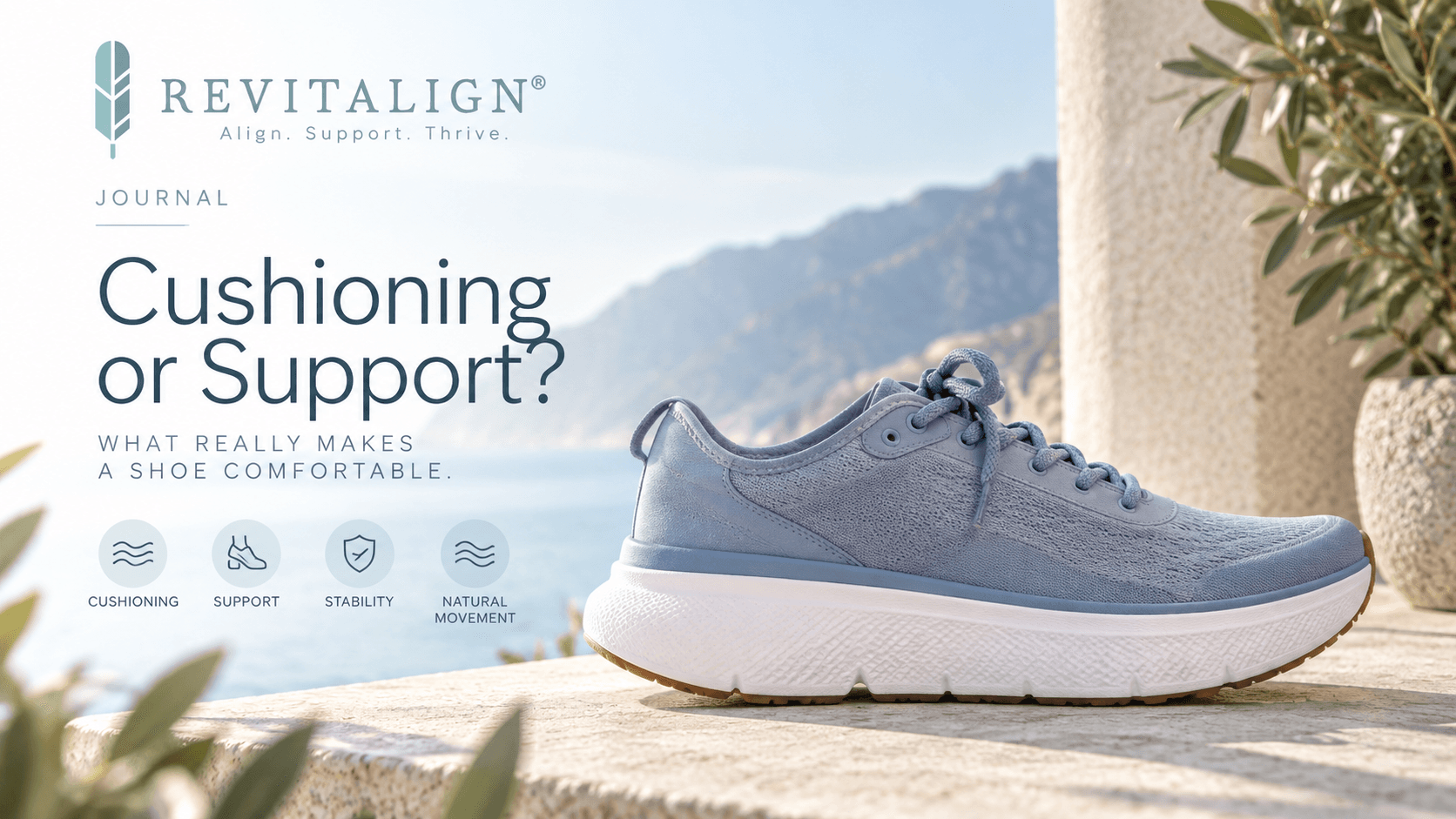
Cushioning or Support? What Really Makes a Shoe Comfortable
by Revitalign Journal Editorial Team|
When we try on a new pair of shoes, we often form our first impression within a few seconds.
We slip them on, take a few steps, and think, “They’re soft, so they must be comfortable.”
It’s an understandable feeling. A soft surface underfoot can immediately give a pleasant sense of comfort. But what we feel in the first few minutes doesn’t always reflect how we’ll feel after several hours.
In fact, a shoe’s comfort depends on a more complex balance.
Cushioning, support, stability, fit, and freedom of movement must all work together.
And it’s precisely this balance—more than just softness—that can make all the difference in everyday life.
Cushioning and softness are not the same thing
Let’s start with an important distinction.
When we talk about softness, we’re primarily describing a sensation: how soft the shoe feels underfoot.
Cushioning, on the other hand, refers to how the shoe’s materials and construction interact with the forces generated during contact with the ground.
That’s why a shoe can feel very soft without necessarily offering the balance we want during a long day.
Similarly, a shoe that initially feels slightly sturdier may turn out to be extremely comfortable during prolonged use.
The point, then, isn’t to look for the softest shoe possible, but rather one that offers a pleasant feel without sacrificing structure and stability.
Cushioning and support are just a few of the elements that contribute to comfort. In our comprehensive guide to comfortable shoes, we also delve into the role of fit, stability, and natural movement.
So why do we love softness so much?
Because it’s immediate.
When we try on a shoe in a store, we have only a few minutes to evaluate it. A soft feel is noticed right away, and our brain easily associates it with comfort.
Support and stability, on the other hand, are less obvious characteristics.
We often don’t think:
“This shoe gives me a stable base.”
We simply move around and feel at ease.
This is an important distinction even when choosing shoes online: what makes a shoe comfortable for many hours can’t always be judged solely by how soft it feels.
The Role of Cushioning
Every step involves an interaction between the foot, the shoe, and the ground.
The midsole and other materials in the shoe help manage this interaction and influence the sensation we feel while moving.
Good cushioning should therefore provide comfort without making us feel like we’re “sinking” too deeply into the shoe.
Think about the difference between sitting on an extremely soft sofa and sitting in a well-designed armchair.
The former may feel fantastic for a few minutes. But if it lacks adequate support, after a while we might find ourselves wanting something more balanced.
With shoes, the principle—albeit with completely different dynamics—can be intuitively similar:
softness and comfort aren’t synonymous.
So, what does “support” mean?
The foot is a complex structure that must adapt to the ground, support the body’s weight, and contribute to the progression of each step.
While walking, it doesn’t remain stationary: it constantly changes shape as it absorbs the load and propels the body forward.
For this reason, talking about support does not necessarily mean talking about a stiff shoe.
Rather, good support should help create a comfortable and stable foundation without preventing the foot from moving naturally.
This is a fundamental distinction.
Support does not mean immobilization
Sometimes the term “support” is immediately associated with corrective or orthopedic footwear.
This isn’t necessarily the case.
A contemporary sneaker can incorporate supportive elements into its construction without looking or feeling like medical footwear.
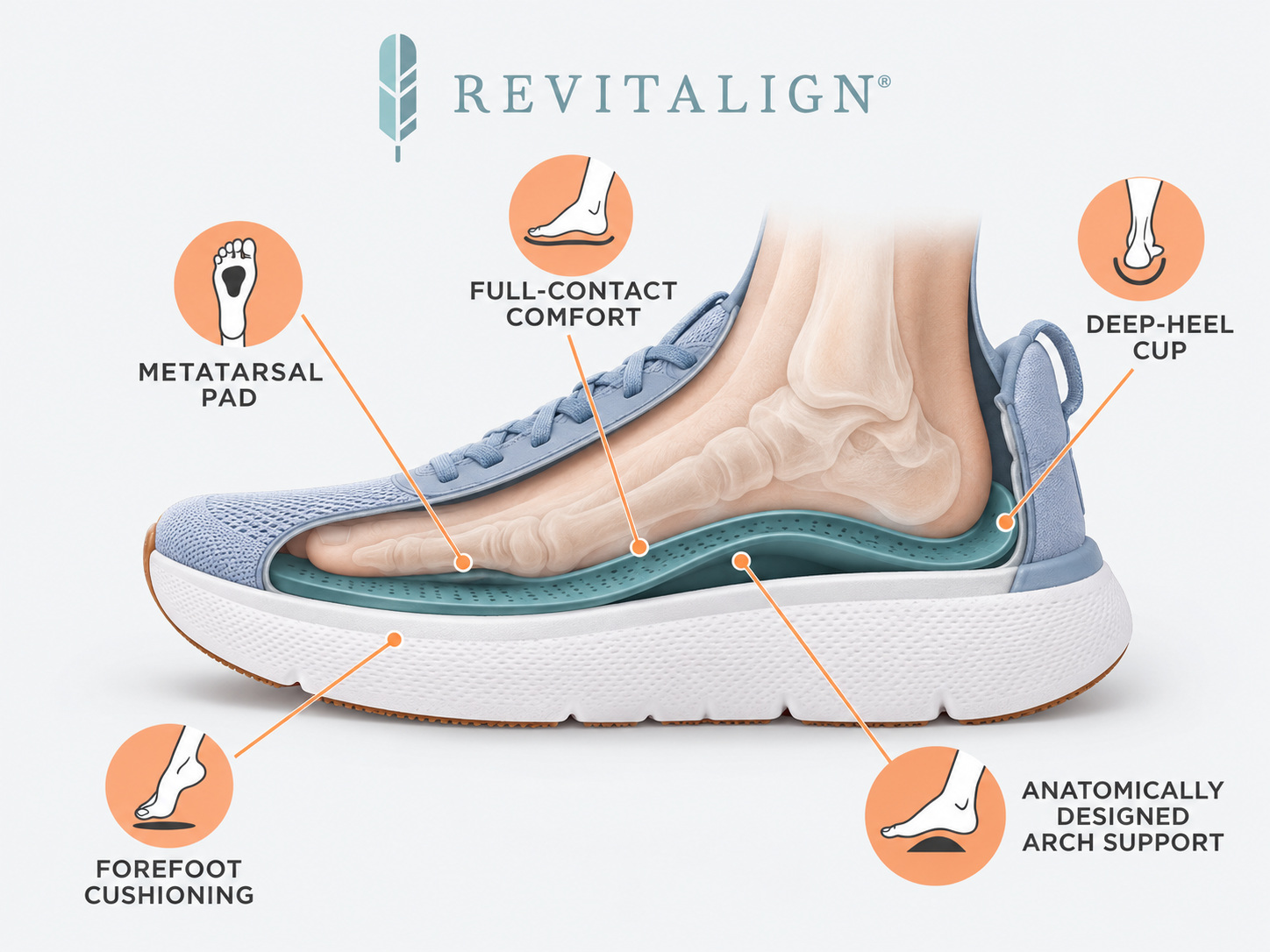
Support can stem from the shoe’s geometry, the shape of the insole, the structure of the midsole, the base of support, and the way the foot is cradled inside the shoe.
The goal should not be to force the foot into an unnatural position.
It should be to support it during movement.
Stability is the third element of the equation
Then there’s a characteristic that’s discussed less often: stability.
We can have a shoe that’s highly cushioned and seemingly comfortable, but if the base under the foot feels excessively unstable, the walking experience can be very different.
Again, this doesn’t mean seeking stiffness.
The ideal situation is to find a balance:
enough cushioning for comfort + enough structure to provide a stable feel.
This is one of the reasons why evaluating a shoe simply by pressing your finger on the midsole or taking a few steps on the floor of a store tells only part of the story.
What about the fit?
We can have excellent materials, good cushioning, and a well-designed support system, but if the shoe doesn’t fit properly, comfort will suffer.
A good fit should leave enough room for your toes, avoid excessive pressure points, and keep your foot stable without constricting it.
And it’s important to remember that feet can change slightly throughout the day, depending on the activities you’re doing and how long you’ve been on your feet.
That’s why comfort comes from the shoe as a whole, not from a single technology.
So, which is better: cushioning or support?
The question, in fact, already contains the problem.
We don’t necessarily have to choose between the two.
A shoe designed for everyday comfort should strike a balance between:
cushioning, support, stability, fit, and natural movement.
If one of these elements completely overshadows the others, the experience can change.
It’s this holistic view of comfort that’s worth considering when choosing a shoe to wear for many hours.
The simplest test? Don’t stop after the first five minutes
When you try on a shoe, the question shouldn’t just be:
“Is it soft?”
Instead, ask yourself:
“Does my foot feel supported?”
“Do I feel stable while walking?”
“Do my toes have enough room?”
“Does the shoe move with my foot without feeling stiff?”
“Would I still want to wear them in a few hours?”
That last question is probably the most interesting.
Because true comfort isn’t what makes an immediate impression. It’s what keeps working throughout the day.
Comfort According to Revitalign
It is precisely this idea that gave rise to the Revitalign approach.
It’s not just about designing a soft shoe, but about finding a balance between comfort, support, and movement in a shoe that can be worn in everyday life.
Models like GAIA embody this philosophy through a design crafted to combine cushioning, support, and stability with the look of a contemporary sneaker.
Because a comfortable shoe doesn’t necessarily have to look like a “technical” shoe.
It can simply be the sneaker you choose because you enjoy wearing it—and continue to appreciate it many hours later.
In conclusion: Look for balance, not just softness
The next time you try on a particularly soft shoe, go ahead and enjoy that pleasant first sensation.
But don’t stop there.
Ask yourself how the support, the shoe’s base, the cushioning, and the fit are constructed.
Because when it comes to everyday comfort, no single feature does all the work.
It’s how these elements work together that makes the difference.
Align. Support. Thrive.
Share