
Back to Blog
Comfort Shoes - Walking Shoes - Foot Comfort - Arch Support - Natural Movement
How to Choose Shoes for Walking All Day
by Revitalign Journal Editorial Team|
When you spend many hours on your feet, true comfort isn't measured in the first few minutes. Find out what features to look for in a shoe designed to get you through the whole day.
There are days when we only notice our shoes when we can finally take them off.
This happens to people who work behind a counter, in a store, at a pharmacy, in an office, at a hotel, or in the restaurant industry. But it also happens to those who travel, run errands, explore a city, take their kids out, or simply love to walk.
Hours on your feet, lots of walking, and by evening, your feet and legs may feel more tired.
As the years go by, we also often become more selective about our footwear. We’re not necessarily looking for the softest shoe. We’re looking for one that makes us feel comfortable and confident in our movements—and that we can continue to wear with pleasure even after many hours.
But how do you recognize it?
The answer starts with a simple concept:
comfort isn’t a single feature. It’s a balance.
The true test of a comfortable shoe comes after a few hours
When we try on a shoe in a store, it only takes a few steps to form a first impression.
A soft insole and an immediate feeling of softness might make us think:
“Now that’s comfortable.”
But our day doesn’t last just five minutes.
We walk, stand still, start walking again, climb stairs, walk on hard floors, and constantly change our pace.
That’s why a shoe designed for all-day wear should offer more than just that initial softness.
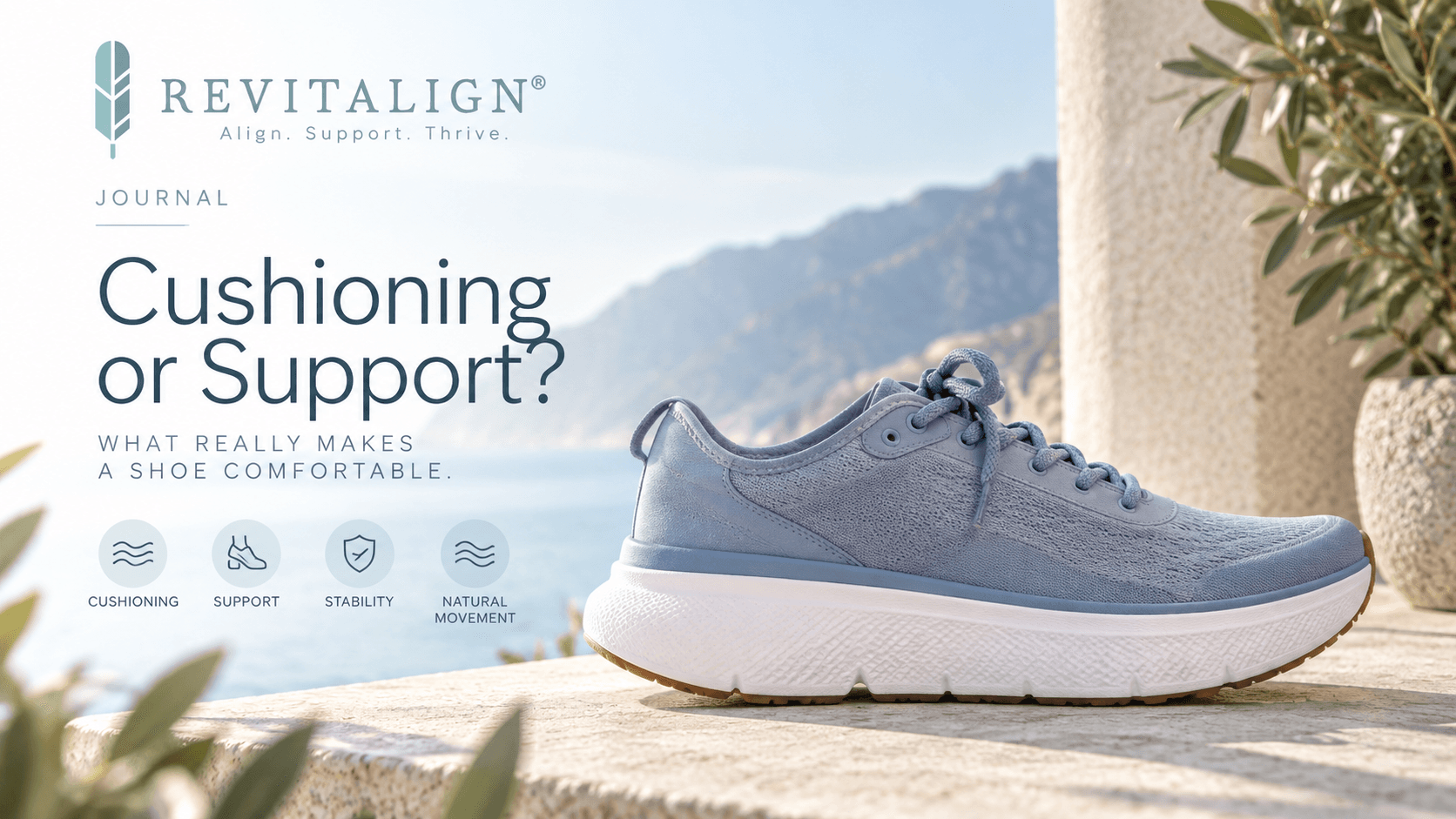
Fit, cushioning, support, stability, flexibility, and weight must all work together.
It’s what we might call dynamic comfort: comfort designed not just for a stationary foot, but for a foot that’s active and on the move.
1. It all starts with the fit
It may seem obvious, but it’s probably the most important point.
The shoe must adapt to the foot, not the other way around.
Your toes should have enough room to move naturally, your heel should feel stable, and there shouldn’t be any noticeable pressure points.
A technologically sophisticated shoe, if it doesn’t fit properly, is unlikely to provide a good experience throughout the day.
And with many hours of use, this aspect becomes even more important.
Comfort starts with the right amount of space in the right places.
2. Cushioning, yes—but not just softness
When we think of a comfortable shoe, we often immediately imagine something very soft.
But softness and comfort aren’t synonymous.
Cushioning is designed to help make the interaction with the ground more pleasant. However, if a shoe is too soft for the wearer’s preferences and needs, the feel may not be what they’re looking for.
That’s why we prefer to talk about balanced cushioning.
The shoe should cushion the impact without compromising the feeling of stability.
This balance is particularly beneficial for those who spend many hours on hard surfaces or constantly alternate between standing and walking.
3. The foot doesn’t just need cushioning—it needs support
The human foot is a complex structure that constantly changes function during each step.
When we walk, ground contact, weight transfer, and the push-off phase occur in succession.
The shape of the shoe and the surface on which the foot rests can therefore contribute to the sensation of support and stability during these movements.
And this is where arch support comes into play.
It doesn’t necessarily mean rigidity.
And above all, it doesn’t mean that a shoe has to look like orthopedic footwear.
In a modern comfort shoe, support can be integrated into the shoe’s design and simply become part of the walking experience.
4. Support and Alignment: What Do They Really Mean?
The word “alignment” deserves some explanation.
The foot doesn’t work in isolation. It’s part of a chain of movement that includes the ankle, knee, hip, and the rest of the body.
When we walk, all these structures are involved in the movement.
A well-designed shoe should not attempt to restrict this natural movement. Rather, the goal is to provide a comfortable and stable foundation that supports the foot as it moves.
This is the meaning Revitalign attributes to the concept of alignment: supporting the foot within a natural and harmonious movement.
Not “forcing” the body into a position.
To accompany it as it moves.
And it is also from this philosophy that ours stems:
Align. Support. Thrive.
5. Stability without a feeling of stiffness
For those who spend a lot of time on their feet, feeling stable can be just as important as feeling cushioned.
Think about a typical workday.
We move sideways, turn around, stop, and start again.
Or think of a long walk through the city, with constantly changing sidewalks, pavements, and surfaces.
The shoe must accommodate these movements.
That’s why a good base of support and a stable construction can contribute to the overall feeling of security and comfort.
But stability doesn’t mean stiffness.
The shoe must still allow the foot to move naturally with each step.
Once again, it’s a matter of balance.
6. A lightweight shoe can make a big difference in your day-to-day experience
There’s also one factor we often overlook when trying on a shoe: weight.
A few grams may seem insignificant.
But a shoe is lifted and moved thousands of times throughout the day.
That’s why a relatively lightweight construction—when combined with support, protection, and stability—can contribute to a feeling of freedom while wearing them.
This doesn’t mean that the lightest shoe is automatically the best.
It simply means that weight is also part of the comfort equation.
The 8-Hour Test
We can, then, change the way we evaluate a shoe.
Instead of just asking ourselves:
“Is it comfortable?”
let’s try asking ourselves:
“Would I still want to be wearing this shoe after eight hours?”
This is what we call the “8-hour test” in the Revitalign Journal.
It’s not a scientific test, and eight hours isn’t a universal benchmark.
It’s a simple way to remember that true everyday comfort must be evaluated over time.
A shoe meant for everyday life should accompany us from morning to afternoon—whether at work, on a walk, on a trip, or during a particularly busy day.
Comfort shouldn’t just be a first impression.
If your feet and legs feel tired at the end of the day
After many hours on your feet or a particularly active day, it’s normal to feel some fatigue.
Shoes cannot eliminate all causes of fatigue and should not be considered a solution to any medical issues.
But we can pay attention to what we wear.
If we wear a pair of shoes every day, it’s worth paying attention to a few very simple signs.
Can’t you wait to take them off?
Do we feel pressure points?
Does your foot feel constricted?
Does the shoe feel unstable?
Or, quite simply, do they no longer feel as comfortable after a few hours as they did at first?
Our bodies provide us with valuable information.
Listening to it is part of the decision-making process.
If, on the other hand, pain, swelling, or other discomfort is frequent or persistent, it’s best to consult a healthcare professional to determine the causes.
Comfort and style can finally go hand in hand
For a long time, a particularly comfortable shoe has been associated with a technical—or, worse yet, “orthopedic”—look.
But today, those seeking comfort don’t necessarily want to sacrifice style.
A woman or man aged 45, 55, or 65 may want more support while still wanting to wear a contemporary sneaker.
It shouldn’t be necessary to choose between feeling good and feeling good about what you’re wearing.
This is an important part of the Revitalign philosophy.
GAIA: Comfort Designed for Everyday Life
Revitalign GAIA fits perfectly within this vision.
GAIA was created as a lifestyle sneaker and embodies some of the principles we’ve discussed: integrated arch support, cushioning, stability, and a construction designed to support everyday movement.
But there’s another element that’s fundamental to us.
It has to look like a sneaker you chose because you like it.
Comfort comes from what happens under and around the foot.
Style is what others see.
And it’s precisely at the intersection of these two worlds that Revitalign aims to build a new vision of comfortable footwear.
Before choosing your next pair of shoes, keep these 5 things in mind
Don’t just look for the softest shoe.
Look for a fit that suits your foot.
Consider the balance between cushioning and stability.
Think of support as part of comfort, not just a synonym for orthopedic shoes.
And above all, ask yourself:
“How would I like to feel in this shoe at the end of the day?”
Because a good shoe isn’t just meant to accompany your first step.
It must also be designed with all the steps that follow in mind.
Align. Support. Thrive.
Sources and Further Reading
Revitalign Journal Editorial Team
This article was developed by the Revitalign editorial team through a review of literature on the biomechanics of walking, footwear comfort, and the interaction between the foot and the shoe.
Among the general references used to provide context for the topics covered:
Perry J., Burnfield J.M., Gait Analysis: Normal and Pathological Function.
Neumann D.A., Kinesiology of the Musculoskeletal System, Elsevier.
Nigg B.M. et al., scientific literature on footwear comfort, movement, and individual preferences.
Journal of Foot and Ankle Research, studies on footwear, comfort, and foot biomechanics.
Gait & Posture, scientific literature on the biomechanics of walking.
The content of the Revitalign Journal is intended for informational and educational purposes only and is not a substitute for the advice of a healthcare professional.
Share